Test of reprojection
In this notebook we will test our reprojection method on 2 frames taken with the Dragonfly instrument. The goal of this notebook is to demonstrate that the results are equivalent and that we gain a speedup using our methodology.
I will also be using astroscrappy to make sure that all cosmic rays and hot pixels are removed from the data before passing it to the reprojection code.
[2]:
!pip install astroscrappy
Collecting astroscrappy
  Downloading astroscrappy-1.2.0-cp310-cp310-manylinux_2_17_x86_64.manylinux2014_x86_64.whl.metadata (3.6 kB)
Requirement already satisfied: astropy in /home/carterrhea/Documents/dfreproject/.venv/lib/python3.10/site-packages (from astroscrappy) (6.1.7)
Requirement already satisfied: numpy in /home/carterrhea/Documents/dfreproject/.venv/lib/python3.10/site-packages (from astroscrappy) (2.2.3)
Requirement already satisfied: pyerfa>=2.0.1.1 in /home/carterrhea/Documents/dfreproject/.venv/lib/python3.10/site-packages (from astropy->astroscrappy) (2.0.1.5)
Requirement already satisfied: astropy-iers-data>=0.2024.10.28.0.34.7 in /home/carterrhea/Documents/dfreproject/.venv/lib/python3.10/site-packages (from astropy->astroscrappy) (0.2025.3.10.0.29.26)
Requirement already satisfied: PyYAML>=3.13 in /home/carterrhea/Documents/dfreproject/.venv/lib/python3.10/site-packages (from astropy->astroscrappy) (6.0.2)
Requirement already satisfied: packaging>=19.0 in /home/carterrhea/Documents/dfreproject/.venv/lib/python3.10/site-packages (from astropy->astroscrappy) (24.2)
Downloading astroscrappy-1.2.0-cp310-cp310-manylinux_2_17_x86_64.manylinux2014_x86_64.whl (1.8 MB)
   ━━━━━━━━━━━━━━━━━━━━━━━━━━━━━━━━━━━━━━━━ 1.8/1.8 MB 7.9 MB/s eta 0:00:00a 0:00:01
Installing collected packages: astroscrappy
Successfully installed astroscrappy-1.2.0
[3]:
from astropy.io import fits
from astropy.wcs import WCS
import time
from dfreproject.reproject import calculate_reprojection
from matplotlib import pyplot as plt
import cmcrameri.cm as cmc
from reproject import reproject_interp
from astroscrappy import detect_cosmics
We now read in the data. Please update this with your own data if you wish to test it locally.
[4]:
light1 = './data/Atik1442426-0035_0032_light.fits'
light2 = './data/Atik1442428-0045_0032_light.fits'

light1_hdu = fits.open(light1)[0]
light2_hdu = fits.open(light2)[0]
light1_wcs = WCS(light1_hdu.header)

light2_hdu.data = detect_cosmics(light2_hdu.data, readnoise=1, gain=0.04)[1]  # We know the effective gain for our detector
Let’s go ahead and visualize these two frames.
[5]:
fig, axs = plt.subplots(1, 2, figsize=(12, 10))

im = axs[0].imshow(light1_hdu.data, origin='lower', cmap=cmc.lipari, vmin=200, vmax=700)
axs[0].set_title(f"Light 1")
plt.colorbar(im, ax=axs[0], shrink=0.5)

im = axs[1].imshow(light2_hdu.data, origin='lower', cmap=cmc.lipari, vmin=500, vmax=1000)
axs[1].set_title(f"Light 2")
plt.colorbar(im, ax=axs[1], shrink=0.5)

plt.show()
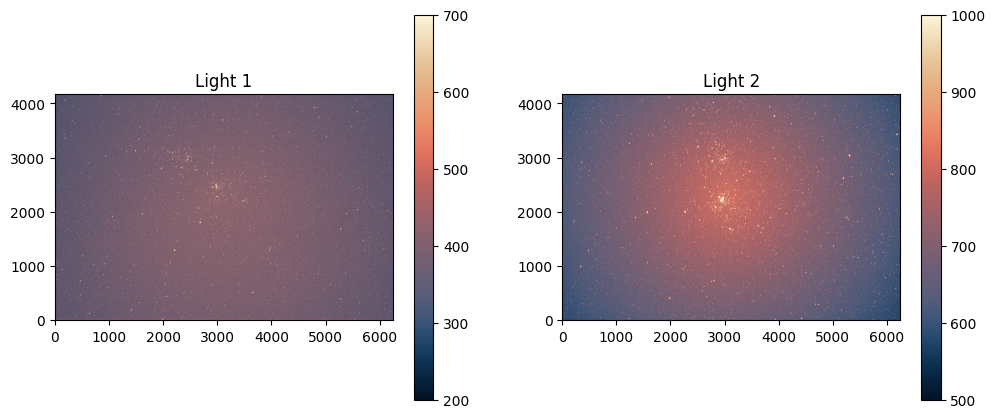
Between these two frames there is some rotation (about 90 degrees) and slight translation.
Reprojection
Now let’s go ahead and do the reprojections using a cubic reprojection.
[6]:
start = time.time()
reprojected_source_torch = calculate_reprojection(source_hdus=light2_hdu, target_wcs=light1_wcs,  shape_out=(light1_hdu.data.shape), order="bilinear")
torch_time = time.time()-start
print(f"total time: {torch_time}")
total time: 1.4365441799163818
[7]:
fig, axs = plt.subplots(1, 2, figsize=(12, 10))

im = axs[0].imshow(light1_hdu.data, origin='lower', cmap=cmc.lipari, vmin=200, vmax=700)
axs[0].set_title(f"Light 1")
axs[0].set_xlim(3200, 3800)
axs[0].set_ylim(1900, 2500)
plt.colorbar(im, ax=axs[0], shrink=0.5)

im = axs[1].imshow(reprojected_source_torch, origin='lower', cmap=cmc.lipari, vmin=500, vmax=1000)
axs[1].set_title(f"Light 2 Torch Reprojection")
axs[1].set_xlim(3200, 3800)
axs[1].set_ylim(1900, 2500)
plt.colorbar(im, ax=axs[1], shrink=0.5)

plt.show()
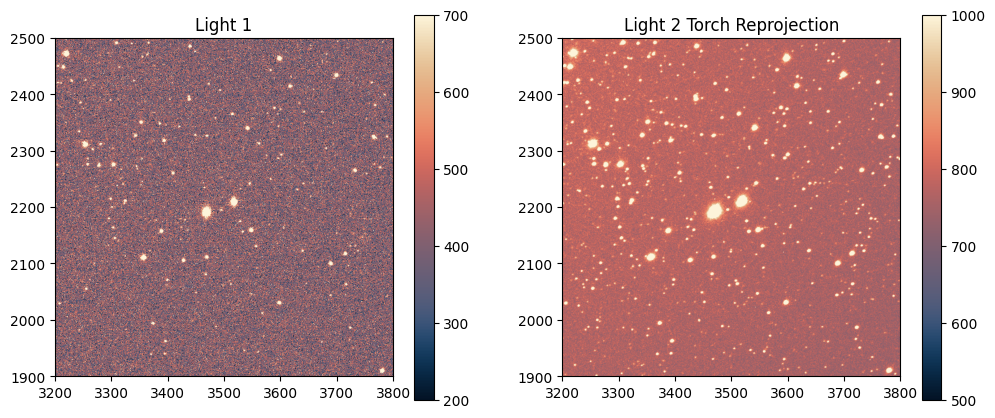
|As we can see the results are extremely similar. The differences are due to how the normalization is handled in our implementation versus reproject_interp.
[8]:
start = time.time()
reprojected_source_reproj = reproject_interp(light2_hdu, light1_hdu.header,order='bilinear')[0]
reproject_time = time.time()-start
print(f"total time: {reproject_time}")
total time: 42.79414224624634
[9]:
fig, axs = plt.subplots(1, 2, figsize=(12, 10))

im = axs[0].imshow(light1_hdu.data, origin='lower', cmap=cmc.lipari, vmin=200, vmax=700)
axs[0].set_title(f"Light 1")
axs[0].set_xlim(3200, 3800)
axs[0].set_ylim(1900, 2500)
plt.colorbar(im, ax=axs[0], shrink=0.5)

im = axs[1].imshow(reprojected_source_reproj, origin='lower', cmap=cmc.lipari, vmin=500, vmax=1000)
axs[1].set_title(f"Light 2 Reproject Reprojection")
axs[1].set_xlim(3200, 3800)
axs[1].set_ylim(1900, 2500)
plt.colorbar(im, ax=axs[1], shrink=0.5)

plt.show()
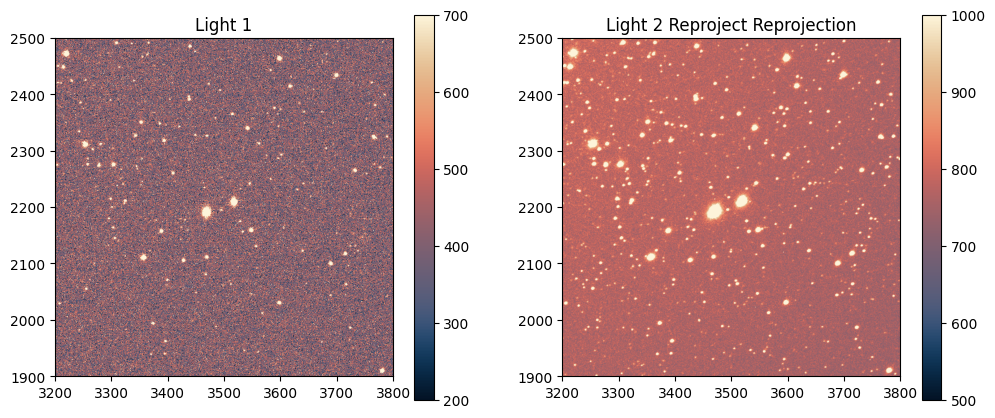
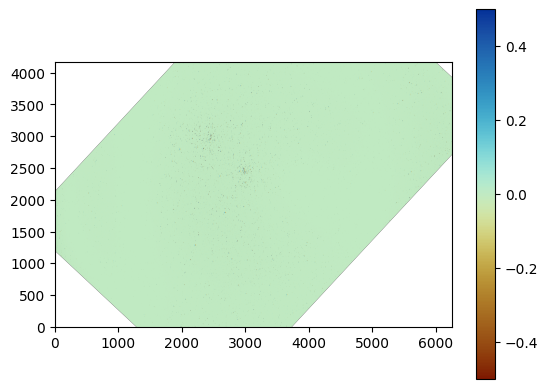
So we can see that the results look consistent accross the methods. Let’s go ahead and double check that by plotting out the residuals.
[10]:
error = 100 * (reprojected_source_torch - reprojected_source_reproj)/reprojected_source_reproj
plt.imshow(error, origin='lower', cmap=cmc.roma, vmin=-0.5, vmax=0.5)
plt.colorbar()
axs[1].set_xlim(3200, 3800)
axs[1].set_ylim(1900, 2500)
plt.show()